Current Issue
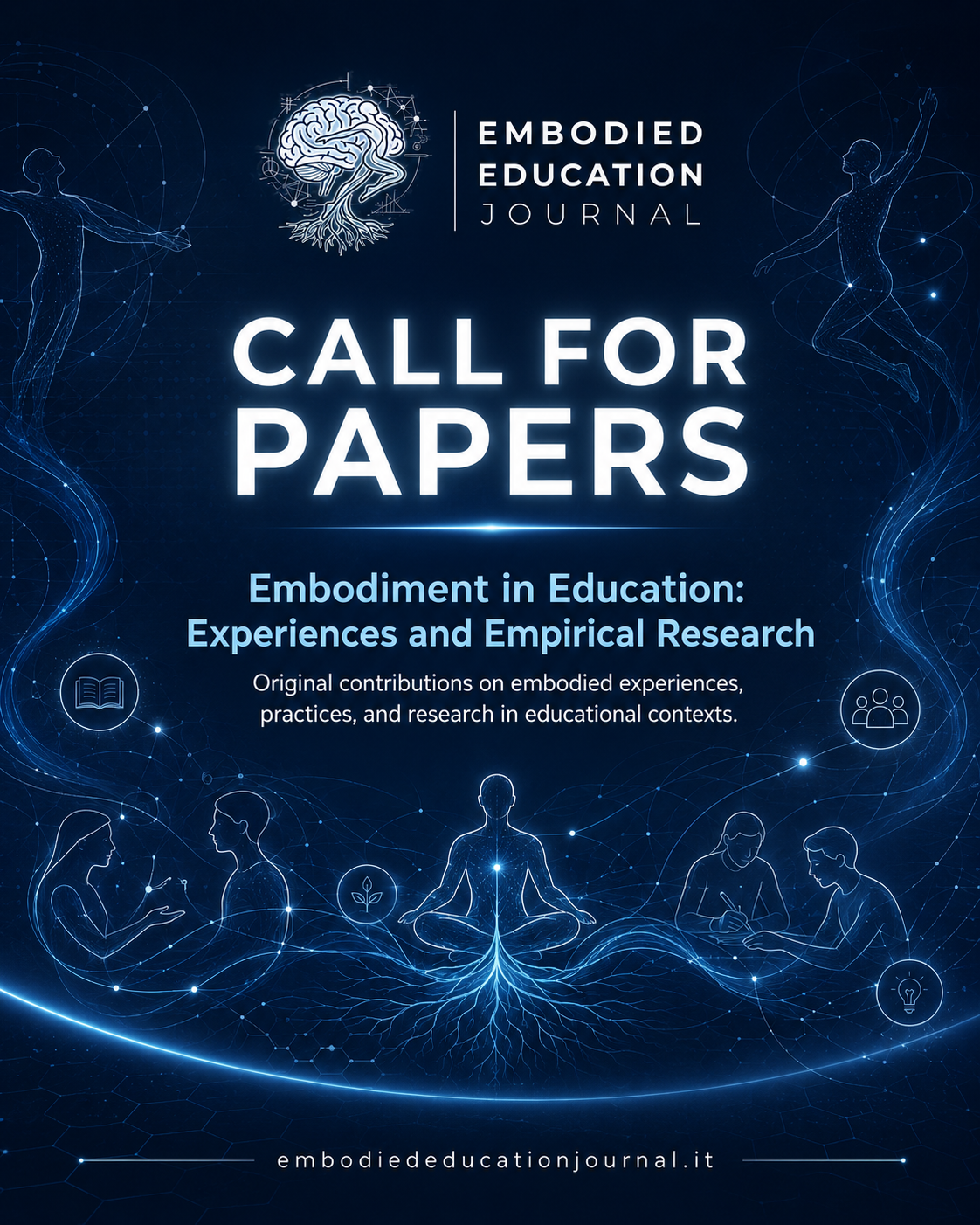
Embodied Education Journal invites scholars, researchers, educators, and professionals to submit original contributions examining embodied experiences, practices, and research in educational contexts.
This Call for Papers focuses on studies in which the body is understood not simply as an object of investigation, but as a constitutive dimension of learning, knowing, relating, and meaning-making.
We welcome contributions that explore how embodied processes emerge through movement, perception, emotion, gesture, posture, spatial interaction, material engagement, and social participation. Particular attention will be given to studies that connect theoretical reflection with empirical evidence, documented educational practices, or clearly defined methodological approaches.
The aim of this issue is to advance the study of embodied education through research that is grounded in concrete contexts and capable of showing how bodies, environments, technologies, and relationships jointly shape educational experience.
Scope and TopicsPossible topics include, but are not limited to:
- embodied learning in schools, universities, and professional education;
- movement, gesture, posture, and sensorimotor activity in teaching and learning;
- perception, emotion, attention, and self-regulation in educational processes;
- situated learning in laboratories, museums, urban spaces, natural environments, and non-formal settings;
- embodied approaches to teacher education and professional development;
- arts-based, performative, theatrical, musical, and narrative practices;
- physical education, sport, psychomotor education, and bodily awareness;
- embodiment, inclusion, disability, and bodily difference;
- empathy, intersubjectivity, imitation, synchrony, and social coordination;
- embodied interaction with digital technologies, immersive environments, and virtual reality;
- embodiment and artificial intelligence in educational contexts;
- materiality, space, and environmental affordances in learning;
- embodied methodologies and multimodal approaches to educational research;
- interdisciplinary perspectives connecting education with psychology, neuroscience, philosophy, anthropology, sociology, movement sciences, media studies, and the arts.
Submissions may address one or more of the following questions:
- How does the body participate in the construction of knowledge?
- How can embodied processes be observed, documented, and interpreted?
- What happens when educational environments actively involve movement, perception, and action?
- What roles do emotion, gesture, posture, rhythm, and interpersonal coordination play in learning?
- How does educational design change when embodiment is treated as a methodological principle?
- Which theoretical, methodological, and ethical challenges arise in embodied research?
- How do bodies, digital technologies, and artificial intelligence interact in educational settings?
- In what ways can embodied approaches support more inclusive, accessible, and participatory forms of education?
The journal welcomes:
- qualitative, quantitative, and mixed-method empirical studies;
- case studies;
- action research and participatory research;
- experimental and quasi-experimental studies;
- methodological contributions;
- documented educational experiences supported by systematic analysis;
- comparative studies;
- systematic reviews and scoping reviews;
- theoretically grounded articles closely connected to practice, data, or research contexts;
- interdisciplinary and multimodal contributions.
Accounts of educational experiences should move beyond descriptive reporting. They should include a clear theoretical framework, an explicit methodology, appropriate documentation, and a critical discussion of findings, limitations, and potential transferability.
Evaluation CriteriaSubmissions will be assessed according to:
- relevance to the scope of the Call for Papers;
- originality and scientific contribution;
- clarity of the theoretical framework;
- methodological coherence and transparency;
- quality of data, evidence, or documentation;
- educational significance;
- ethical awareness;
- capacity to connect experience, analysis, and critical interpretation.
All manuscripts will undergo the journal’s peer-review process.
Submission GuidelinesManuscripts must be original, unpublished, and not under consideration by another journal.
Submissions must be made through the online platform of Embodied Education Journal. Authors are required to follow the journal’s editorial and bibliographic guidelines and to ensure that the manuscript submitted for review is fully anonymised.
LanguagesSubmissions are accepted in English or Italian.
Important Dates- Abstract submission deadline: [01/07/2026]
- Notification of abstract acceptance: [10/07/2026]
- Full manuscript submission deadline: [15/07/2026]
- Completion of peer review: [30/07/2026]
- Expected publication: [August 2026]
Embodied Education Journal
Journal website:
https://embodiededucationjournal.it
Embodied Education
An embodied, situated and transformative perspective on educational processes
Over the last few decades, the international scientific community has progressively questioned traditional models of learning based on an abstract, computational and disembodied conception of the mind. These models, inherited from classical cognitivism, have long interpreted cognition as an internal process of symbolic processing, separate from the bodily dimension, the environmental context and social relations. This approach has contributed to shaping a vision of education focused primarily on the transmission and processing of information, neglecting the complexity of lived experience.
Within this scenario, the paradigm of Embodied Cognition marked a significant epistemological turning point. It proposes the hypothesis that cognitive processes cannot be understood independently of the body that supports them, the environments that stimulate them, and the relationships that structure them. Cognition is thus understood as a phenomenon emerging from the dynamic interaction between perception, action, emotion, and context. It is no longer a question of conceiving the mind as an isolated system that represents the world, but as an embodied process that takes shape in the continuous exchange between organism and environment.
The journal Embodied Education is situated within this theoretical and cultural horizon, taking education as a complex, situated and co-evolutionary phenomenon. Learning is not interpreted as a simple accumulation or internal reworking of data, but as a process that emerges from the intertwining of body, mind, emotions, practices of action and socio-cultural contexts. Educating and training, in schools, universities, professional and corporate settings, therefore means generating conditions of experience in which the subject learns through doing, perceiving, feeling and relating, in a continuous dialogue between biological, symbolic and social dimensions.
Theoretical foundations and disciplinary convergences
The theoretical roots of this approach lie in philosophical and scientific traditions that are different but deeply convergent. Phenomenology has highlighted how the body is not an object among objects, but rather the original locus of meaning and experience. The lived body constitutes the condition of possibility for perception and relationship, making every cognitive act intrinsically situated.
Embodied and enactive cognitive sciences have further developed this insight, arguing that cognition emerges from the structural coupling between organism and environment. In this perspective, knowing means co-constructing the world through action, rather than representing it in a neutral and detached way. Contemporary neuroscience has reinforced this view by showing how emotions, decision-making processes and cognitive activities are deeply intertwined and rooted in corporeality. The affective dimension is not an accessory element of thought, but a constitutive component.
At the same time, studies on embodied intersubjectivity have highlighted how understanding others and social learning are based on mechanisms of motor and emotional simulation. Knowledge, language and identity are thus configured as outcomes of embodied and socially situated practices, rooted in shared experience and the relational dimension.
Education as a co-evolutionary process
Taking an embodied perspective means rethinking education as a dynamic and complex system in which biological, psychological, social, cultural and technological dimensions influence each other. Educational processes do not follow linear trajectories nor are they exhausted in simple causal patterns; rather, they emerge from networks of interactions in constant transformation. Learning thus becomes a co-evolutionary phenomenon, in which subjects, environments and tools change each other over time.
In this context, education cannot be reduced to the transmission of content, but must be understood as a process of situated co-construction of knowledge. Material contexts, bodily practices, digital technologies and social configurations actively participate in the generation of meaning. The integration between the physical dimension and media environments continuously redefines the ways in which learning, teaching and training are designed.
An open and rigorous editorial project
Embodied Education aims to be an open, pluralistic and methodologically rigorous space for scientific discussion. The journal does not identify with a single theoretical model, but seeks to foster critical dialogue between different approaches that share a focus on the embodied and situated nature of educational experience. It welcomes contributions from a variety of disciplines, promoting fruitful interaction between pedagogy, psychology, neuroscience, philosophy, anthropology, sociology, motor sciences and media studies, as well as between theoretical research and empirical evidence.
Particular importance is given to the dialogue between basic and applied research, in the belief that methodological innovation must be based on solid conceptual frameworks and that theoretical reflection finds an essential testing ground in the comparison with educational practices. The journal aims to contribute to the construction of an educational philosophy capable of critically interpreting contemporary transformations in education systems and guiding their development.
Training and transformations in the digital age
In the current historical context, marked by pervasive digitalisation processes and new configurations of experience, education finds itself immersed in a hybrid condition in which the online and offline dimensions are deeply intertwined. Digital technologies and artificial intelligence are not simply external tools, but environments with which individuals enter into a structural relationship, redefining practices, languages and modes of presence.
In this scenario, Embodied Education aims to be a place for scientific elaboration and cultural exchange, capable of offering interpretative keys and project perspectives for the academic, school and business worlds. Rethinking education in an embodied way means recognising that every educational process is always situated, relational and dynamic: an event that takes shape in the body, develops through interaction and transforms over time.
EEJ is published by
Edizioni Universitarie Romane
Via Michelangelo Poggioli 3
Roma RM
00161 Italia
06491503 - 064940658 – 0644361377 - 064940658
http://www.eurom.it